
Dinosaurs
The dinosaurs (literally ‘terrible lizard) descended from an archosaur ancestor and two lines diverged relatively early in dinosaur evolutionary history, giving rise to two major groups. The Saurischia (lizard hips) had a more primitive hipbone arrangement as in the archosaur ancestors, and the Ornithischia (bird hips) had a modified hipbone arrangement, similar to that of modem day birds. The prosauropods were a primitive Saurischian, a group that eventually gave rise to the sauropods, e.g. Brachiosaurus.
Massospondylus carinatus
The most ubiquitous of the fossilized dinosaur species found on Sentinel (there are at least fifteen different sites) is the prosauropod, Massospondylus carinatus, a long-necked, smallish, most likely herbivorous (but possibly omnivorous) species. They were gregarious and moved in herds. Most sites where their fossils are found contain numerous specimens.
Massospondylus are known to have lived 210-190 million years ago, on the Triassic/Jurassic cusp, and may have been opportunistic carrion feeders, grazing on riverbank foliage most of the time. Although they grew to approximately 6m in length, they had relatively small heads (about the size of a fox terrier’s) with small, serrated, leafblade-shaped teeth.
Few Massospondylus skulls have ever been discovered, as it is believed that the skull bones were lightweight and delicate, therefore less prone to fossilization (though one complete skull was discovered in South African and is housed in the Iziko South African Museum in Cape Town). Like ostriches, they swallowed stones (gastroliths) to aid digestion and many gastroliths have been found amongst their fossils.
Armed with vicious hooked claws on their hands and feet, they seem to have had very able defence mechanisms.
Massospondylus fossils have been found not only in Southern Africa, but also in South America, North America, Madagascar and India, and its occurrence on all four continents is often called upon to illustrate and prove the theory of Continental Drift.
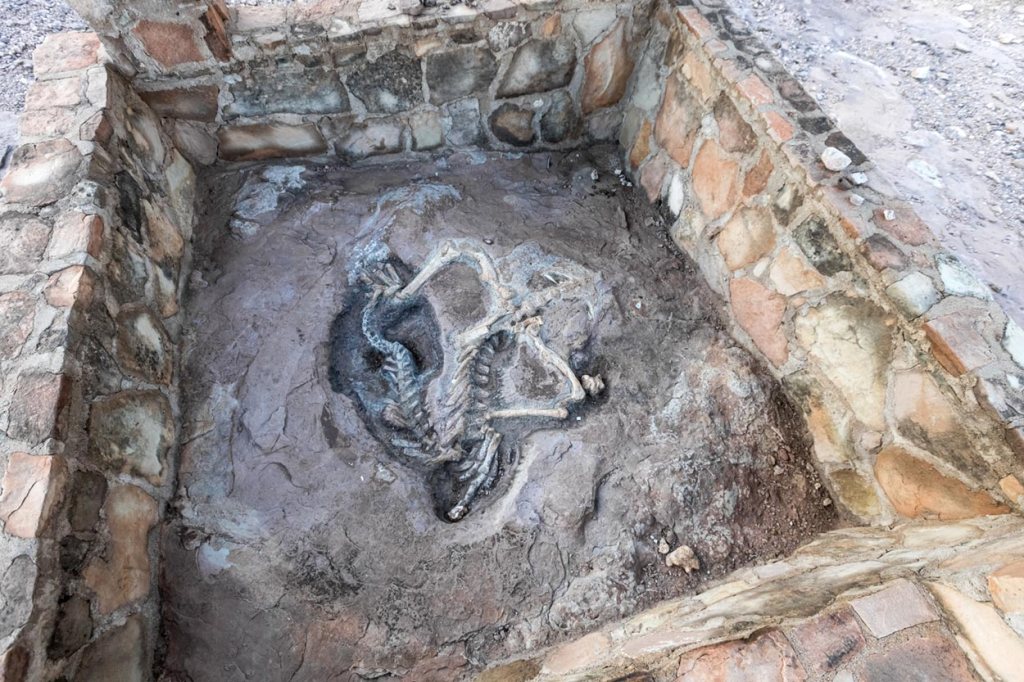
The most interesting of all the Massospondylus sites on Sentinel is “Penny”, named after the late Penny Bristow who, with a group of friends, found its bones emanating from a smooth sandstone surface on a hillside on the farm in 1993. Enough of this specimen’s skeleton was visible to see that much of its body was still intact and lying articulated in situ within the sandstone matrix. The fossil was initially worked on by the South African palaeontologist, Francois Durand, then of the Geological Survey of South Africa, and his meticulous work in removing the sandstone deposit around the bones was a precursor to further work done by his field successors from the Natural History Museum in Bulawayo. The work was completed by Dr Darlington Munyikwa, who at the time was working with the Natural History museum in Bulawayo.
Euskelosaurus
On the Pimwa Mountain – the flat-topped, basalt capped mountain directly across from the Sandstone Camp, numerous fossils of what may prove to be the primitive dinosaur Euskelosaurus were discovered by Adam Bristow when, as a young boy, he was booted from the camp kitchen on Christmas Day so his mother could get on with preparing the Christmas dinner in peace. The fossils were found in a steep erosion gully on the side of the hill, where rain gushes off the mountain. With the help of his father, a sizeable collection of fossils were removed for safe-keeping and are now housed at the Border Ridge homestead. Remarkably, three left femurs of varying sizes were found, indicating that at least three specimens were preserved at this site. The herbivorous Euskelosaurus walked on all fours, had a long neck and reached a height of approximately 3m, and a length of over 6m.
Palaeontologists are currently reviewing the classification of the so-called “Euskelosaurus” specimens found at Sentinel, which may in fact be Sefapanosaurus or Melanorosaurus, two heavy-boned sauropodomorphs that could be an important missing link between Massospondylus (an early prosauropod), and the true sauropods that evolved much later.
Megapnosaurus
Tracks of a smaller Triassic dinosaur species, Megapnosaurus (formerly Syntarsus), have also been found. There is a wealth of fossilised material being discovered within the hills and valleys of this remarkable landscape.
 Sentinel Limpopo Eco Safaris